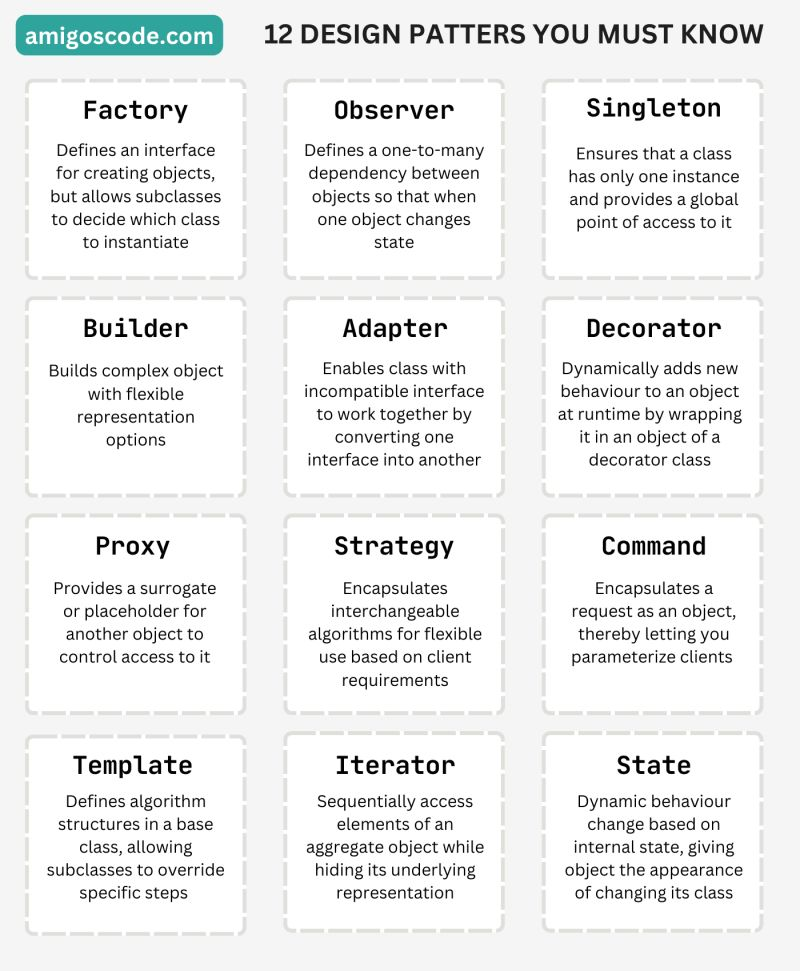

1. Factory Pattern 🏭
Imagine a factory that produces different products. Similarly, this pattern creates objects without specifying their exact class, making code flexible and easy to extend. 🧩
2. Observer Pattern 🔍
Like subscribing to updates! Objects (observers) register to watch changes in a subject. When the subject changes, observers are notified automatically. 📡🔔
3. Singleton Pattern 🕊️
The one and only! Ensures a class has only one instance globally accessible. Useful for managing shared resources like databases. 🌐🔒
4. Builder Pattern 🛠️
Building complex objects step by step. Think of it as assembling Lego bricks to create something intricate without the mess! 🧱🏗️
5. Adapter Pattern 🌉
Bridging the gap! Converts the interface of one class into another interface clients expect. Makes incompatible components work together. 🔌🔌
6. Decorator Pattern 🎈
Like adding toppings to your pizza! Dynamically adds responsibilities to objects without changing their code. A flexible alternative to subclassing. 🍕✨
7. Proxy Pattern 🕶️
Virtual representative! Controls access to an object, acting as a stand-in with additional functionality, like lazy loading. 🔒🔍
8. Strategy Pattern 🎯
Switching strategies seamlessly! Allows selecting algorithms during runtime. Useful when you want to provide multiple ways to accomplish a task. 🎮🔄
9. Command Pattern ⌨️
Encapsulates requests as objects, allowing parameterization of clients with different requests and queuing of requests. Think of it as a to-do list for your program. 📋📌
10. Template Pattern 📄
Standardized process steps! Defines the structure of an algorithm, letting subclasses override specific steps. Ideal for reusable workflows. 📊📈
11. Iterator Pattern 🔄
Tour guide for collections! Provides a way to access elements of a collection without exposing its underlying representation. 🚶♂️🗺️
12. State Pattern 🚦
Like a traffic light! Allows an object to change its behavior when its internal state changes. Keeps your code organized as states pile up. 🚥🔄